Assessing Breast Cancer Risk Using Deep Learning: How Keydiag® Data Can Accelerate Screening
Published on 3 August 2026
Each year, nearly 2 million women worldwide are diagnosed with breast cancer. In France, approximately 60,000 new cases are diagnosed each year. Despite advances in screening and treatment, it remains the most common cancer among women. However, when detected early, the five-year survival rate is well over 80%, underscoring the importance of early diagnosis.
In the face of this major public health challenge, artificial intelligence is opening up new possibilities. Among the most promising technologies is the Deep learning, whose performance depends above all on one essential factor: the quality of the data used to train the algorithms.
Deep Learning in Medical Imaging
Deep learning is a branch of machine learning. It relies on artificial neural networks composed of multiple layers of analysis. Inspired by the human brain, these models identify complex relationships in large volumes of data.
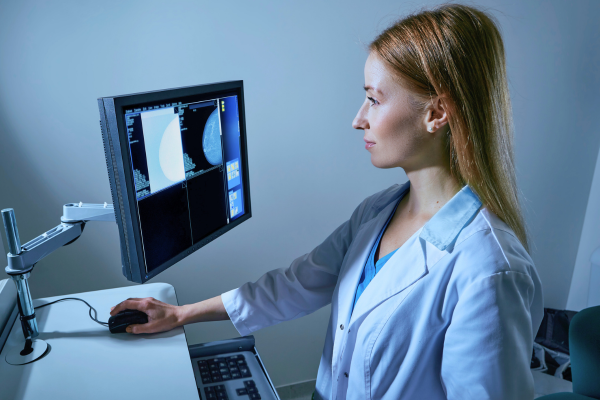
In radiology, this technology is gradually becoming a powerful decision-support tool. In particular, it can detect abnormalities in medical images, automatically segment lesions, and help characterize certain breast tumors.
Without high-quality data, there can be no effective AI
The performance of a deep learning model depends directly on the data used to train it. However, in radiology, much of the clinical information remains difficult to utilize: reports are often written in free-form text or archived in PDF format, which limits their use for research.
To develop robust algorithms, researchers need standardized, structured, and easily analyzable data. This is precisely the added value of the data produced by Keydiag®.
For more than ten years, Keymaging has been supporting radiologists with Keydiag®, a platform for creating structured radiology reports.
In addition to standardizing practices, the solution generates consistent and standardized clinical data. This data is more easily usable for research and the development of artificial intelligence models.
The reports generated via Keydiag® are gradually building a particularly rich knowledge base for training and evaluating future artificial intelligence models.
Toward a More Accurate Assessment of Breast Cancer Risk
Thanks to deep learning, this data can be leveraged on a large scale to develop and train models that can improve the assessment of individual patient risk.
Structured data from Keydiag® can, in particular, help develop models that enable:
- improve early cancer detection,
- refine the assessment of individual risk,
- track patients’ progress over time,
- help identify the factors associated with the risk of recurrence,
- help estimate the likelihood of response to certain treatments,
- to support research on metastatic risk and recurrence-free survival.
One of the main advantages of these approaches is their ability to incorporate a patient’s examination history. Risk assessment is no longer based solely on a single examination. It can evolve over time as new information is added to the patient’s care journey.
Data: The Driving Force Behind the Medicine of Tomorrow
The goal of these technologies is not to replace the radiologist, but to provide them with decision-making tools that are increasingly reliable and effective.
By converting each test result into structured data, Keydiag® helps lay the foundation for future generations of artificial intelligence algorithms. As this knowledge base grows, it can foster the development of increasingly effective models. These models could improve early detection, personalize patient care, and advance predictive medicine.
Now more than ever, data is emerging as the true driving force behind artificial intelligence in healthcare.