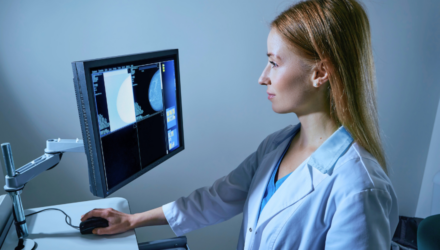
AI in emergency rooms: fantasy or reality?
Published on 11 December 2025
With the rise of assisted imaging technologies, the idea of entrusting the interpretation of emergency X-rays to AI, or at least part of this task, is gaining ground in many places.
In some hospitals, up to 75% of emergency X-rays are no longer reviewed by a radiologist, reflecting both the pressure on staff and current organizational limitations.
New AI tools are now capable of efficiently sorting normal images from suspicious ones, with a low error rate. This sorting capability has the potential to ease the burden on examination workflows and allow doctors to focus on the most complex cases.
Real progress… but supervision is essential
Recent advances enable AI to identify a wide range of anomalies and propose an initial classification level of “normal/not normal.”
However, interpreting an X-ray remains above all a comprehensive medical procedure, which depends on the clinical context, the patient’s history, and sometimes subtle nuances that are difficult for an algorithm to capture.
Even though it is highly effective, AI cannot yet reproduce this overall vision. That is why human supervision remains essential.
The medico-legal issue: a non-negotiable point
From a medico-legal perspective, standard X-rays are frequently involved in litigation. The ultimate responsibility for a diagnosis cannot be transferred to a machine. Human interpretation remains essential, even if AI is involved upstream in the analysis process. This is a topic we are following closely at Keymaging.
A powerful lever for training
Beyond the clinical aspect, AI opens up a promising avenue: that of assisted teaching. The ability to understand algorithmic reasoning, visualize areas of attention, and compare normal with pathological findings could become a major asset in the training of interns, particularly in the interpretation of standard images.
Data structuring: an often underestimated pillar
We often forget that the reliability of medical AI depends first and foremost on the quality and structure of the data that feeds it. In the field of medical imaging, AI can only be effective if it is based on information that has been validated by experts and complies with the standards of learned societies. Without this solid foundation, algorithms lose reproducibility and decision support becomes less effective.
Keydiag® by Keymaging was developed taking this into consideration: a solution designed by radiologists for radiologists. It combines clinical rigor with visual innovation through structured and diagrammatic reports.
Among its advantages: assistance in classifying pathologies, clear visualization of lesions facilitating communication with surgeons, and more confident medical practice based on reliable data.
By securing reasoning and strengthening forensic security, Keydiag® optimizes productivity without ever replacing human expertise
Chez Keymaging, la structuration de la donnée n’est pas un simple détail : c’est un prérequis essentiel. It enables the provision of reliable, reproducible, and truly useful clinical assistance. Well-organized data is not a bonus: it is the very prerequisite for reliable and relevant AI.
AI as a co-pilot, not a substitute
AI is now a powerful tool for sorting and interpretation, but it can in no way replace human expertise. At Keymaging, we agree on this point: the most realistic, secure, and effective approach remains AI–physician co-piloting, combining technological precision with clinical judgment.
This vision guides the development of our Keydiag by Keymaging solution, a structured medical intelligence system designed by and for radiologists. Our goal is clear: to enhance medical expertise through the reliability of our data and decision support, without ever replacing the radiologist.
Let us continue to explore together the future of imaging, where technology supports human expertise but does not replace it.